Do You Know?
★ 95% of car buyers now research online for an average of 14 hours before visiting a dealership, according to recent industry data.
This shift highlights the crucial role of effective lead management in converting digital inquiries into showroom visits. As competition intensifies in the automotive sector, Business Development Centers (BDCs) have become indispensable for car dealerships aiming to boost appointment setting and drive sales growth.
In today’s fast-paced market, where consumers expect seamless experiences across channels, BDCs are evolving from simple call centers into sophisticated hubs for lead qualification, real-time follow-up, and lead conversion. At Virtual BDC, we specialize in providing outsourced solutions that help dealerships like yours navigate these changes, ensuring more showroom visits and higher efficiency. This blog explores the latest trends in BDC for car dealerships, with a strong emphasis on appointment-focused strategies, backed by authentic stats and insights from official sources.
Understanding the Role of BDC in Car Dealerships
A BDC for car dealerships acts as the frontline for managing inbound leads, nurturing prospects, and scheduling appointments. Unlike traditional sales teams, BDCs focus on high-volume interactions through phone, email, text, and live chat support, filtering out unqualified leads to deliver ready-to-buy customers to the sales floor.
This department has grown in importance as digital marketing generates more leads than ever. For instance, a 2025 report highlights that over 80% of buyers start their journey on third-party sites, making efficient BDC operations essential for capturing market share. By prioritizing appointment setting, BDCs not only improve lead conversion rates but also enhance overall dealership performance.
The Evolution of BDC: From Call Centers to Strategic Assets
BDCs have transformed significantly over the years. Initially focused on outbound calls, they now integrate advanced tools for multichannel communication and data-driven decisions. This evolution is driven by consumer demands for personalization and speed, as evidenced by NADA’s 2025 Mid-Year Report, which notes a 7.1% increase in new vehicle sales SAAR from June to July 2025, partly attributed to better lead handling.
Key milestones include the adoption of CRM integration, which allows seamless data flow, and the rise of AI to automate routine tasks. As we look toward 2026, BDCs are poised to become even more integral, with a focus on cost efficiency through virtualization and outsourcing.
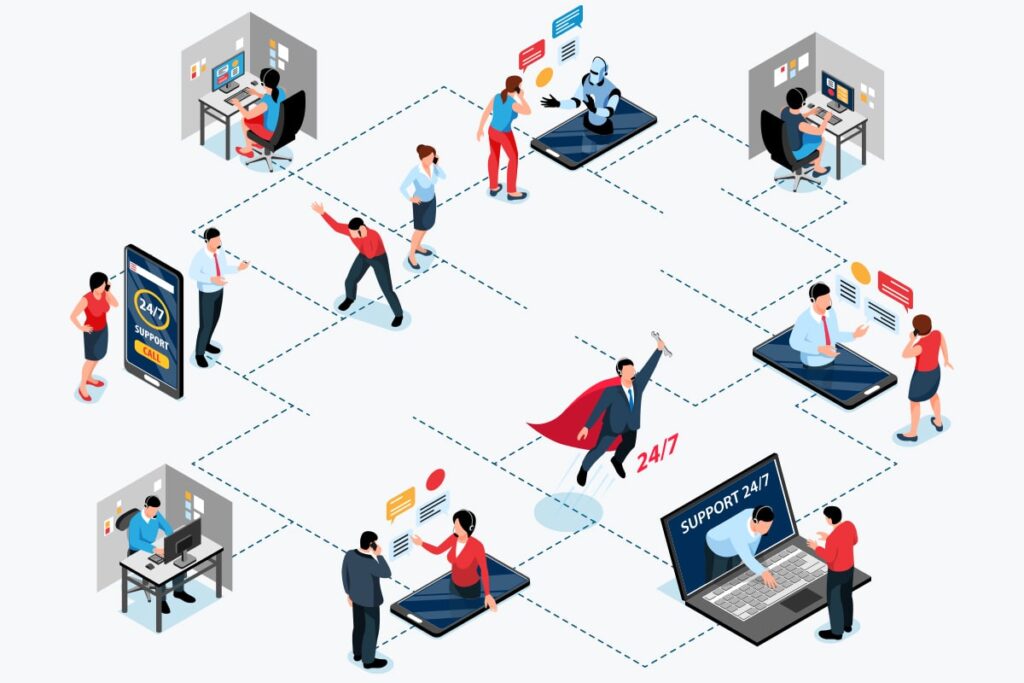
Key Trends Shaping BDC for Car Dealerships in 2026
The automotive industry is on the cusp of major changes, with BDCs at the forefront. Here are the top trends, complete with predictions and supported by data from credible sources like Cox Automotive and NADA.
1. Real-Time Follow-Up and the 5-Minute Benchmark
Speed is king in lead management. The 5-minute benchmark, responding to inquiries within five minutes, has become a standard for success. Research shows that leads contacted within this window are up to 100 times more likely to be qualified than those delayed by 30 minutes. In the automotive space, 13% of dealers achieve this, leading to significantly higher appointment setting rates.
This trend is amplified by tools enabling instant responses via live chat support and automated texts. Dealerships adopting this see lead conversion jumps of 21-100 times.
Prediction
★ By the end of 2026, over 70% of high-performing dealerships will meet the 5-minute benchmark consistently, driven by AI automation, resulting in 30-50% more showroom visits.
For real-world discussions, check this Reddit thread on BDC sales strategies, where users share tips on quick responses to boost appointments: Internet / BDC sales.
2. Multichannel Communication for Seamless Engagement
Consumers interact across multiple platforms, from social media to website chats. Multichannel communication ensures no lead slips through, integrating phone, SMS, email, and social messaging into one system.
According to Cox Automotive’s 2026 trends report, unified workflows like this boost customer experience and profits. This approach supports real-time follow-up and personalized interactions, key to lead qualification.
Benefits include:
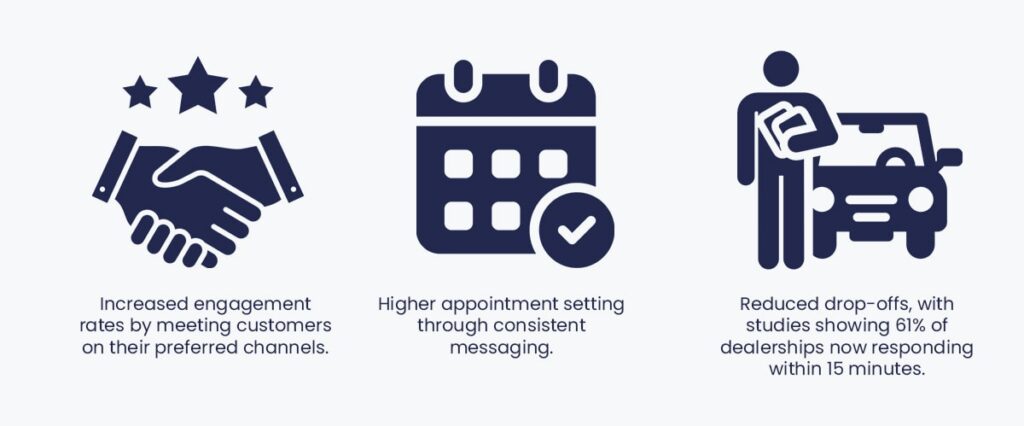
- Increased engagement rates by meeting customers on their preferred channels.
- Higher appointment setting through consistent messaging.
- Reduced drop-offs, with studies showing 61% of dealerships now responding within 15 minutes.
Prediction
★ In 2026, 85% of BDCs will adopt full omnichannel strategies, leading to 25% improvements in lead conversion.
A Quora discussion on dealership experiences highlights the value of excellent communication: What makes a car dealership experience actually enjoyable.
3. AI-Powered Lead Qualification and Conversion
AI is revolutionizing BDCs by automating lead qualification, scoring prospects, and even handling initial chats. Tools like AI BDCs from providers such as Traver Connect enable 24/7 operations, transforming lead management.
In 2026, AI will be non-optional, with dealerships using it for call analytics and workflow automation. This leads to cost efficiency by reducing staffing needs while increasing showroom visits.
| AI Application in BDC | Benefits | Predicted Adoption by 2026 |
| Chatbots for Initial Inquiries | Instant responses, 24/7 availability | 75% of dealerships |
| Predictive Lead Scoring | Prioritizes high-intent prospects | 60% increase in conversions |
| Automated Appointment Setting | Reduces manual errors, boosts efficiency | 80% of BDCs |
Prediction:
★ 2026 will see AI handling 50% of BDC tasks, yielding 40% higher lead conversion rates.
Reddit users discuss AI sales assistants for efficient appointment setting: Why do you guys use AI sales assistants?.
4. Deeper CRM Integration for Personalized Experiences
CRM integration allows BDCs to access real-time data, enabling tailored follow-ups that build trust. Integrated systems track interactions, predict needs, and streamline multichannel communication.
NADA’s 2025 Workforce Study notes that better tools contribute to higher retention and performance. This trend supports lead qualification by identifying hot leads quickly.
Prediction:
★ By mid-2026, 90% of dealerships will have fully integrated CRMs, driving 35% more personalized engagements and showroom visits.
5. Cost Efficiency Through Outsourcing and Virtualization
With operational costs rising, outsourcing to virtual BDCs offers 24/7 coverage without in-house overhead. Providers like Virtual BDC deliver expert support in appointment setting and real-time follow-up at lower costs.
This aligns with 2026 trends toward stability amid uncertainties like tariffs.
| In-House BDC vs. Outsourced BDC | In-House | Outsourced |
| Cost Structure | High fixed costs (salaries, training) | Variable, pay-per-lead models |
| Availability | Limited to business hours | 24/7 coverage |
| Scalability | Challenging during peaks | Easily scalable |
| Expertise | Dependent on internal hires | Access to specialized teams |
Prediction:
★ Outsourcing will grow by 40% in 2026, enhancing cost efficiency and lead conversion.
A Quora thread on investing in dealerships touches on efficiency trends: What things should a person consider before investing in a car dealership business.
Challenges in Implementing BDC Trends
Adopting the latest BDC trends for car dealerships offers great potential, but dealerships often face significant obstacles. These challenges can hinder real-time follow-up, appointment setting, and overall lead conversion. Below is a concise overview of the key issues.
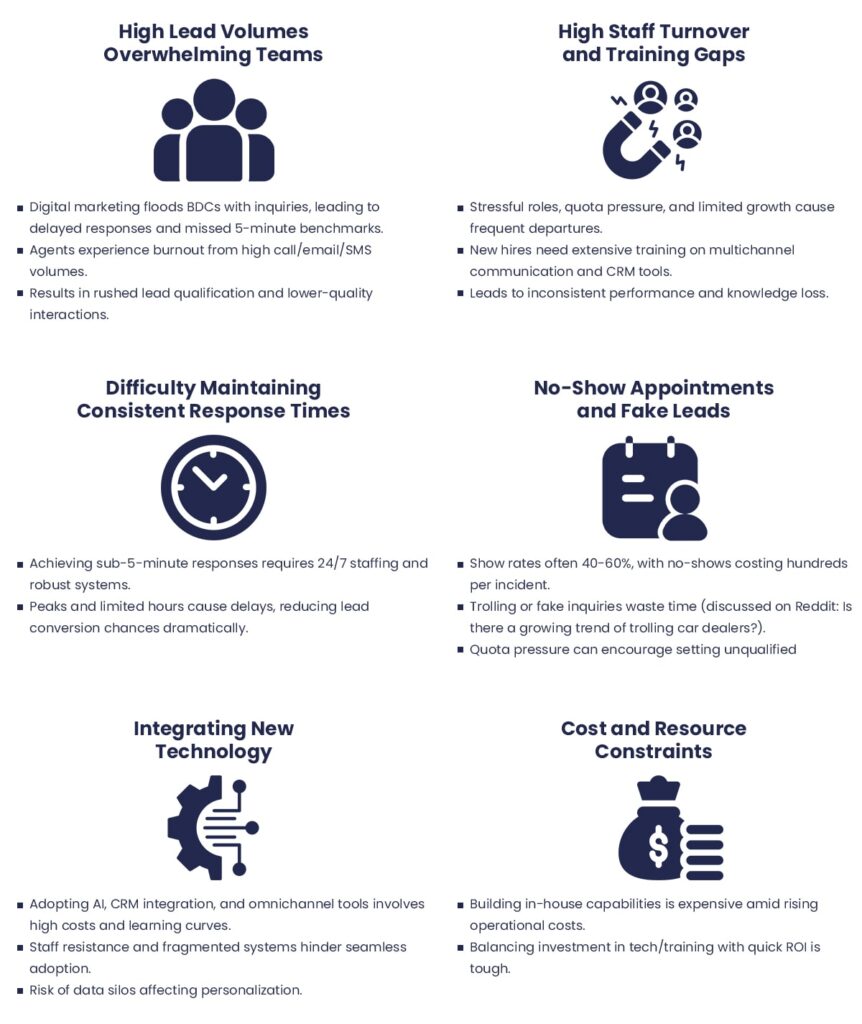
High Lead Volumes Overwhelming Teams
- Digital marketing floods BDCs with inquiries, leading to delayed responses and missed 5-minute benchmarks.
- Agents experience burnout from high call/email/SMS volumes.
- Results in rushed lead qualification and lower-quality interactions.
High Staff Turnover and Training Gaps
- Stressful roles, quota pressure, and limited growth cause frequent departures.
- New hires need extensive training on multichannel communication and CRM tools.
- Leads to inconsistent performance and knowledge loss.
Difficulty Maintaining Consistent Response Times
- Achieving sub-5-minute responses requires 24/7 staffing and robust systems.
- Peaks and limited hours cause delays, reducing lead conversion chances dramatically.
No-Show Appointments and Fake Leads
- Show rates often 40-60%, with no-shows costing hundreds per incident.
- Trolling or fake inquiries waste time (discussed on Reddit: Is there a growing trend of trolling car dealers?).
- Quota pressure can encourage setting unqualified appointments.
Integrating New Technology
- Adopting AI, CRM integration, and omnichannel tools involves high costs and learning curves.
- Staff resistance and fragmented systems hinder seamless adoption.
- Risk of data silos affecting personalization.
Cost and Resource Constraints
- Building in-house capabilities is expensive amid rising operational costs.
- Balancing investment in tech/training with quick ROI is tough.
Many dealerships overcome these by partnering with outsourced providers like Virtual BDC for scalable, expert support without internal overhead. The next section covers strategies to address them effectively.
Strategies to Overcome Challenges and Maximize BDC Efficiency
Overcoming the common hurdles in BDC for car dealerships requires proactive, data-driven approaches. By implementing targeted strategies, dealerships can improve real-time follow-up, reduce no-shows, boost staff retention, and drive higher lead conversion and showroom visits. Here are proven tactics to address these issues effectively.
- Invest in AI and CRM Integration for Automation: Use AI tools to handle initial inquiries, lead scoring, and automated reminders, freeing agents for high-value interactions and ensuring consistent 5-minute benchmark responses.
- Provide Comprehensive Training and Development: Offer ongoing training in product knowledge, sales techniques, objection handling, and multichannel communication to build confidence and reduce turnover.
- Implement Lead Scoring and Prioritization: Score leads based on budget, timeline, and intent to focus efforts on high-potential prospects, preventing overload and improving lead qualification.
- Adopt Multi-Touch Confirmation and Reminder Systems: Send automated texts, emails, calendar invites, and video confirmations; follow up with phone calls the day before to minimize no-shows and boost show rates by 20-30%.
- Personalize Customer Interactions: Reference past inquiries, vehicle preferences, and browsing history in communications to build rapport and trust, leading to higher engagement and appointment setting.
- Track and Analyze Key Metrics Regularly: Monitor KPIs like response time, appointment show rate, and conversion; use dashboards for real-time insights to identify issues early and refine processes.
- Improve Staff Retention Through Incentives and Culture: Offer competitive pay, career growth paths, performance bonuses, and a supportive environment to combat high turnover and maintain consistent expertise.
- Partner with Outsourced or Virtual BDC Providers: Leverage specialists like Virtual BDC for 24/7 coverage, specialized training, and scalability without in-house overhead, enhancing cost efficiency and performance.
- Deploy Omnichannel Communication Tools: Integrate phone, SMS, email, live chat, and social into a unified platform for seamless engagement across customer preferences.
- Focus on Quality Over Quantity in Interactions: Train agents to emphasize value-building and solution-oriented conversations rather than aggressive quotas, reducing fake appointments and improving genuine lead conversion.
These strategies, when combined, create a resilient BDC that turns challenges into opportunities for growth in 2026. Dealerships partnering with experts like Virtual BDC often see the fastest results in overcoming obstacles and maximizing efficiency.
Official resources like the NADA Economy reports provide further guidance on trends.
| Key BDC Metrics | 2025 Benchmark | 2026 Prediction |
| Lead Response Time | 15 minutes (61% of dealers) | Under 5 minutes (70%) |
| Conversion Rate | 20-25% | 30-40% with AI |
| Appointment Show Rate | 50-60% | 70% via personalization |
Looking Ahead: Predictions for BDC in 2026 and Beyond
2026 will be the year of AI dominance in BDCs, with predictions including widespread adoption of virtual agents and deeper analytics for lead qualification. Expect lead conversion to rise as showroom visits become the ultimate KPI.
NADA’s Mike Stanton reflects on 2025 wins, previewing tech-driven growth. Dealerships embracing these trends will see sustainable revenue boosts.
At Virtual BDC, we’re here to help implement these strategies.