What Is a Sales BDC and Why Mid-Size Dealerships Need One in 2026
A Sales BDC (Business Development Center) is the dedicated team responsible for managing inbound and outbound sales leads, qualifying interest, handling follow-up across phone/text/email/chat, setting firm showroom or virtual appointments, and nurturing prospects until they arrive. Unlike the sales floor (focused on closing), the BDC exists to create opportunities.
For mid-size dealerships, this function is essential because:
- You generate enough leads to justify dedicated handling, but not enough to support a large in-house team without inefficiency.
- After-hours and weekend inquiries (often 30-50% of volume) go unanswered without 24/7 coverage.
- Speed wins: responding within 5 minutes can increase conversions 21x (longstanding benchmark still valid in 2026).
- Show rates suffer without reminders and structured follow-up. Industry average hovers 40-55%, while optimized BDCs hit 55-70%.
Without a strong Sales BDC, leads leak, and revenue follows.
Suggested Read: AI Sales BDC: Tools and Strategies to Boost Conversion Rates in 2026
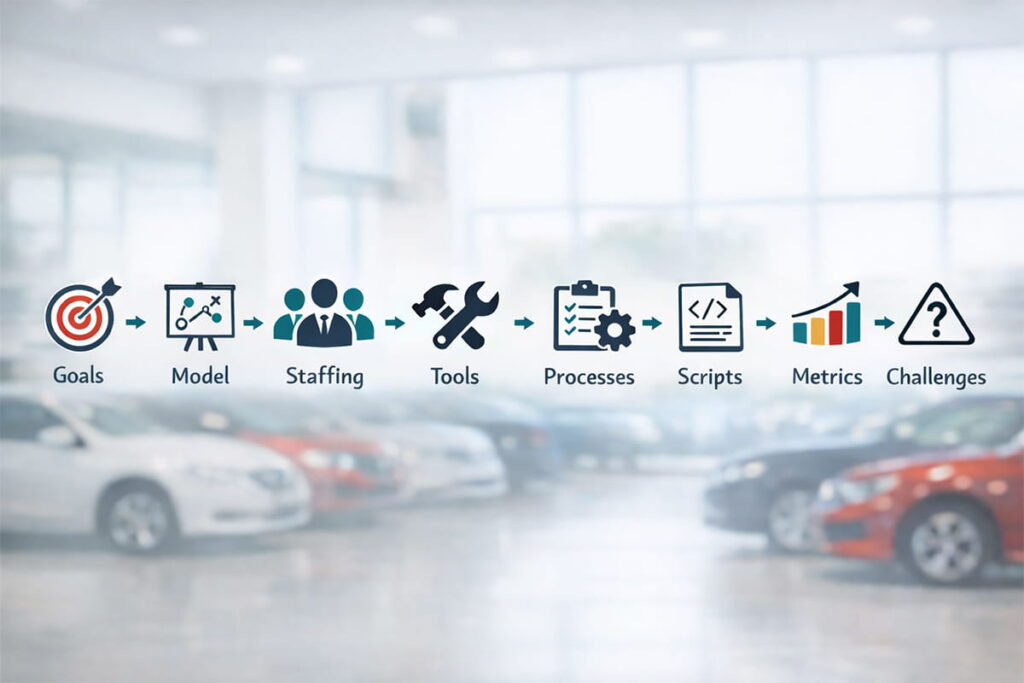
Step 1: Define Your Sales BDC Goals and Structure
Start with clarity. Vague goals create vague results.
Recommended Goals for Mid-Size Dealerships in 2026:
- Respond to 90%+ of leads within 15 minutes (ideally <5 min).
- Set appointments on 20-40% of contacted leads (source-dependent).
- Achieve a 55-70% show rate through reminders and confirmation.
- Increase total showroom traffic by 25-40% from BDC efforts.
- Maintain cost per appointment under $50-$75 (mid-size benchmark).
Structural Options:
- Dedicated BDC: A separate team focused only on lead management.
- Shared BDC: Handles both sales and service (common in mid-size stores).
- Hybrid: Core in-house + outsourced/virtual support for coverage/scalability.
Real-Life Example: In a case study from DataClover for Habberstad BMW, defining clear BDC goals around lead response and appointment setting led to retained service customers and $24,681 in mark-up gross profits within 4 months.
Relevant Case Study: DataClover Habberstad BMW Case Study
Action: Hold a leadership meeting. Write down 3-5 SMART goals. Align everyone (GM, sales manager, BDC lead) on what success looks like.
Step 2: Choose the Right Model (In-House, Outsourced, Hybrid)
Mid-size dealerships have three realistic paths in 2026:
- In-House Model
○ Full control, brand consistency.
○ Cost: $200k–$350k+/year (salaries, benefits, turnover, tools).
○ Best if: You have low lead volume or strong existing staff.
- Outsourced/Virtual Model
○ 24/7 coverage, no hiring headaches, predictable costs ($4k-$8k/month typical).
○ Best if: You want to scale fast without overhead.
- Hybrid Model (Most Recommended for Mid-Size)
○ AI + in-house core + virtual agents for overflow/after-hours.
○ Combines speed (AI), personalization (humans), and cost control.
○ Delivers 25-40% appointment growth with 30-60% savings vs. full in-house.
Real-Life Example: A mid-size CDJR dealership in the Bay Area (Flai case study) used a hybrid model to handle 1,563 calls, book 304 appointments, and generate $83,000 profit, a 19% conversion from all calls.
Relevant Case Study: Flai San Leandro CDJR Case Study
2026 Reality Check: Pure in-house struggles with coverage and turnover. Pure outsourced can feel disconnected. Hybrids win because they balance both.
Interesting FactA 2026 Automotive News Dealer Outlook Survey revealed that 68% of dealers expect profits to remain steady or increase in 2026, with many mid-size stores adopting hybrid BDC support to offset flat new-vehicle margins and achieve an average $87,000 increase in annual gross profit from enhanced lead management. Source: Automotive News – 2026 Dealer Outlook Survey: How Car Dealers Can Stay Profitable. |
Step 3: Staffing and Training Your BDC Team
Ideal Mid-Size Staffing:
- 2-4 dedicated agents (full- or part-time) + 1 supervisor.
- Hours: 10-12/day weekdays + virtual/outsourced after-hours/weekends.
- Compensation: Base + commission on appointments set/shown (motivates results).
Training Essentials:
- Week 1: Dealership basics, inventory, processes, brand voice.
- Week 2: Scripts/word tracks + objection handling.
- Week 3: CRM/tool training + role-play.
- Ongoing: Weekly coaching, call reviews, metric reviews.
Pro Tip: Use recorded calls and AI sentiment tools for feedback, and agents improve 30% faster.
Real-Life Example: Park Ave Acura (DataClover case) trained a small BDC team on structured qualification, resulting in retained service customers and profit gains.
Relevant Case Study: DataClover Park Ave Acura Case Study
Step 4: Select Tools and Technology Stack
Must-have stack for 2026:
- CRM: VinSolutions, DealerSocket, or Tekion (central hub).
- Phone/Text Platform: RingCentral, Aircall, or built-in CRM tools.
- AI Assist: Podium, Numa, or BDC.AI for scoring/chat/reminders.
- Analytics: Built-in dashboards or third-party (e.g., Volie).
- Integration: Ensure seamless lead flow (no double entry).
Budget: $500-$2,000/month for mid-size.
Real-Life Example: Freeman Lexus (Flai case) integrated AI tools, handling ~1,100 calls to book 376 appointments and $100,000 profit at 88% bookable rate.
Relevant Case Study: Flai Freeman Lexus Case Study
Step 5: Build Processes. Lead Intake, Qualification, Appointment Setting
Core Process Flow:
- Lead Intake: All channels route to BDC (website forms, calls, chats).
- Qualification: 3-5 key questions (intent, timeline, budget).
- Appointment Setting: Offer specific times, confirm via text/email.
- Follow-Up Cadence: Day 1, 2, 4, 7, 14 (text/call mix).
- Handoff: Warm transfer to sales rep with notes.
Document in a shared playbook. Review quarterly.
Real-Life Example: A struggling dealership in Strolid’s case built intake processes, addressing overwhelmed BDC and inconsistent follow-ups, leading to higher conversions.
Relevant Case Study: Strolid Human Side of AI in BDC
Step 6: Master Scripts, Word Tracks, and Follow-Up Cadence
Effective Script Framework:
- Greeting + Permission
- Quick Qualification
- Value Presentation
- Appointment Close
- Objection Handling
- Confirmation
Sample Word Track (Inbound Call):
“Hi [Name], this is [Your Name] with [Dealership]. Thanks for reaching out about the [Vehicle]. Are you looking to see it today or schedule a test drive this week?”
Follow-Up Cadence:
- Immediate text confirmation.
- Day 1 reminder.
- Day 2-3 value add (e.g., “Here’s a quick video walkaround”).
- Day 7 re-engagement if no show.
Real-Life Example: Uniserve BDC case emphasized script mastery and reminders, increasing show rates through proper confirmation and response.
Read More: Uniserve BDC on Show Rates
Step 7: Track the Right Metrics and Optimize Weekly
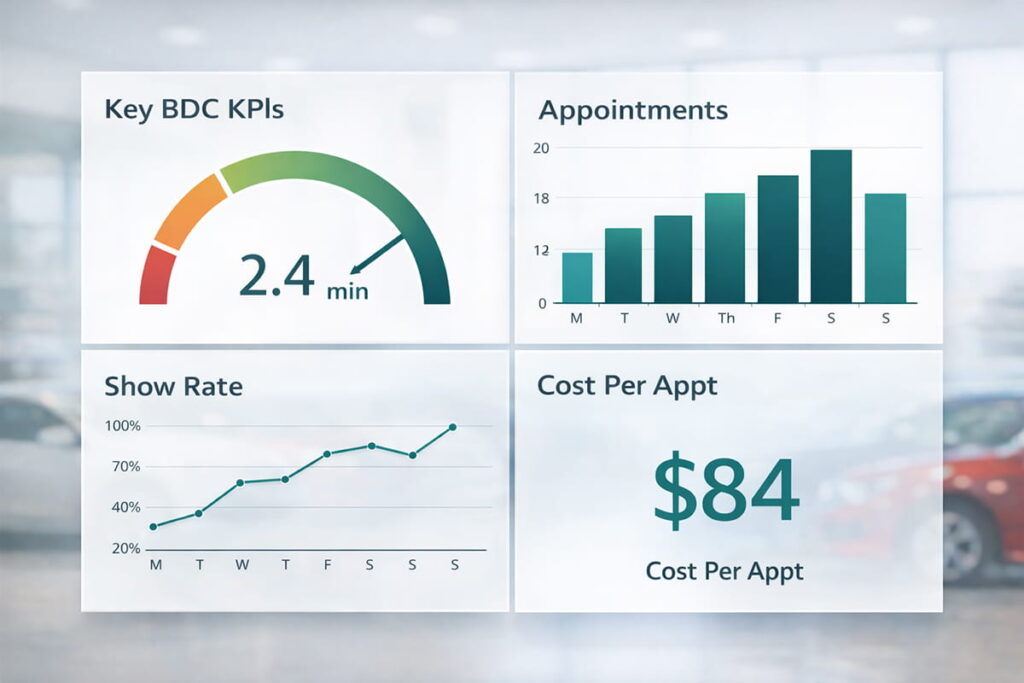
Must-Track KPIs:
- Response Time (<15 min target)
- Contact Rate (% leads reached)
- Appointment Set Rate (20-40%)
- Show Rate (55-70%)
- Cost per Appointment
- Conversion to Sale
Real-Life Example: Foureyes.io benchmarks show optimizing metrics led to higher set rates by lead type, with monthly improvements in internet/phone leads.
Read More: Foureyes Appointment Set Rates
Step 8: Overcome Common Mid-Size Dealership Challenges
- Staff Turnover → Competitive pay + clear career path.
- After-Hours Gaps → Hybrid/virtual support.
- Low Show Rates → Automated reminders + pre-appointment videos.
- Compliance → TCPA/FTC-ready tools and consent tracking.
Real-Life Example: Willowood Ventures case for a mid-size dealership overcame no-shows with 41% show rate, selling 37 units for $162,430 gross.
Related Reads: Willowood Ventures Automotive Case Studies
Real Results: Mid-Size Dealerships That Got It Right
- Mid-size Chevy dealer: Built hybrid BDC → 35% appointment increase, $90k+ added profit.
- Multi-franchise group: Optimized follow-up cadence → Show rates from 45% to 62%.
Suggested Read: Virbdc.com AI Sales BDC Blog
What Dealers Are Saying: Insights from Reddit and Quora
Reddit r/askcarsales: “BDC Advice? Tips?” Dealers discuss goals, staffing challenges, and tools for success.
External link: Reddit Thread on BDC Advice
Reddit r/askcarsales: “BDC 1st month progress and advice: Insights on processes, scripts, and metrics.
External link: Reddit Thread on BDC Progress
Reddit r/askcarsales: “Tips for a new BDC agent and eventually manager?” Experiences with BDC roles and setup.
External link: Reddit Thread on New BDC Agent Tips
Final Word: Launch Your High-Performing Sales BDC in 2026
A high-performing Sales BDC isn’t a luxury. It’s how mid-size dealerships compete with the big groups in 2026. Start small, measure everything, iterate fast. The payoff is more showroom traffic, higher conversions, and a sustainable edge.