What Is a Hybrid Sales BDC?
To set the stage in our narrative, let’s define the key terms clearly because understanding the foundation is like knowing the engine under your hood before hitting the road.
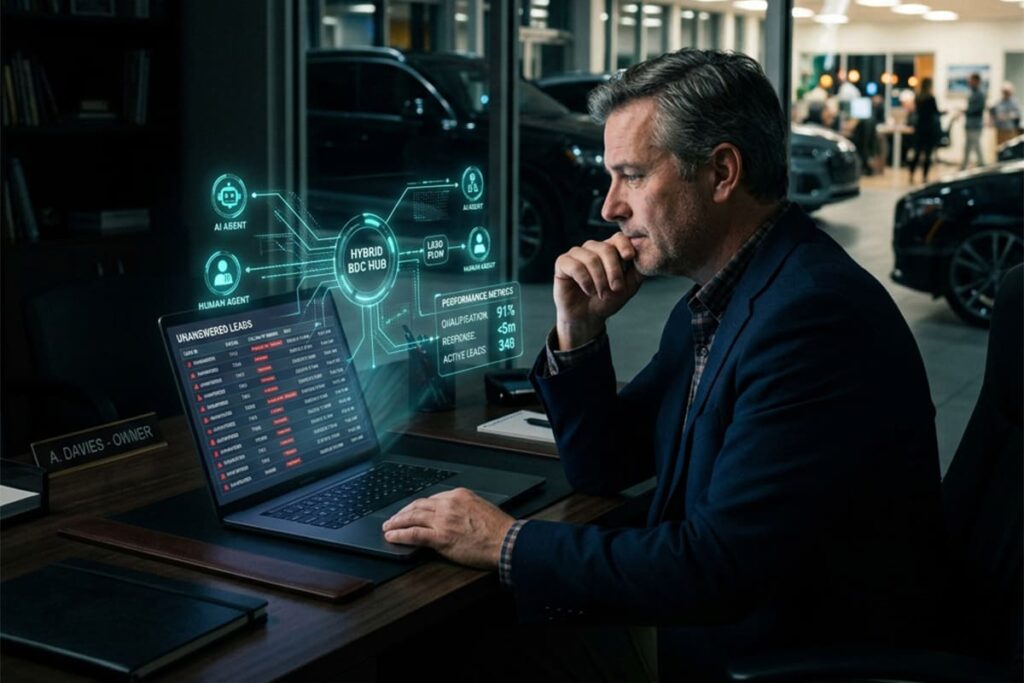
Definition: Hybrid Sales BDC – A hybrid sales BDC (Business Development Center) is a lead management system that integrates artificial intelligence (AI) for automated tasks like initial contact, lead scoring, and basic follow-up with human agents for deeper engagement, qualification, and closing. In 2026, this model emphasizes seamless handoffs, ensuring AI handles volume (e.g., 24/7 chat responses) while humans add empathy and expertise, aligning with mid-size dealership needs for cost-effective scalability.
Key Related Terms:
- AI Layer: The automated component using tools like chatbots or sentiment analysis to respond instantly and prioritize leads based on intent signals.
- Human Layer: Trained reps (in-house or virtual/outsourced) who step in for personalized interactions, often via phone, text, or video.
- Handoff Protocol: The critical bridge where AI escalates qualified leads to humans, preventing drop-offs and maintaining flow.
- CRM Integration: Essential for hybrids, this connects systems like DealerSocket or VinSolutions to ensure data sync and real-time insights.
This hybrid approach isn’t new, it’s evolved from early 2020s experiments, but in 2026, with AI adoption at 76% among dealers, it’s become the narrative hero for mid-size stores, blending tech’s efficiency with the human stories that build lifelong customers.
The Evolution of BDC in Dealerships: A Narrative Shift in 2026
Picture Alex’s dealership in the early days: a simple phone line and a few dedicated reps handling leads the old-fashioned way. Fast-forward to 2026, and the BDC landscape has transformed into a dynamic ecosystem where hybrids reign supreme. Traditional in-house models, once the staple, now strain under turnover rates of 50-100% and costs exceeding $250,000 annually for a small team. Pure AI setups, while flashy, often falter in nuanced negotiations, leading to lost trust and lower show rates.
The shift to hybrids? It’s a story of adaptation. Industry data shows hybrids outperform by delivering 32% higher conversions through AI’s speed (under 5-minute responses) and humans’ rapport-building. For mid-size dealerships, this narrative means surviving economic pressures, like rising labor costs and digital competition, while thriving with tools that feel like an extension of your team. As Alex discovered, hybrids aren’t about replacing people; they’re about empowering them to focus on what matters: turning leads into loyal customers.
Fun FactDid you know that in 2026, dealerships using hybrid sales BDC models report an average $90,000 annual profit boost from recaptured after-hours leads alone? According to a CDK Global study, this stems from AI’s ability to engage 30-50% of off-peak inquiries, which humans then convert at rates 20% higher than traditional methods, proving hybrids are the unsung heroes of the bottom line. |
Why Mid-Size Dealerships Are Turning to Hybrid Models This Year
In our story, Alex’s turning point came when he realized mid-size dealerships, those selling 50-200 units monthly, face unique hurdles: enough leads to demand dedicated handling, but not the budget for expansive teams. Why hybrids in 2026? The year marks a peak in AI maturity, with 76% of dealers investing in tech to combat staffing shortages and meet buyer expectations for instant, personalized service.
Pain points solved:
- Coverage Gaps: Hybrids provide 24/7 AI responses, capturing leads that would otherwise vanish.
- Cost Pressures: Slash expenses by 30-60%. No full-time hires for volume spikes.
- Performance Plateaus: AI scoring prioritizes hot leads, humans close them, lifting show rates to 55-70%.
Government influences play a role too: FTC guidelines emphasize secure data handling in BDCs, and hybrids with built-in compliance tools (like encrypted AI chats) make adherence easier. For Alex, this meant not just surviving, but scaling his family’s legacy without sacrificing the personal touch.
The Top 5 Hybrid Sales BDC Models
Now, the heart of our narrative: the models themselves. We’ll dive deep into each, imagining how they fit Alex’s dealership, with expanded descriptions, sub-examples, and why they shine for mid-size stores in 2026.
Model 1: AI + Outsourced/Virtual Human Hybrid
This top-ranked model uses AI for initial triage (scoring leads based on behavior and intent) and outsourced virtual agents for follow-up and closing. Narrative: For Alex, this was the breakthrough, AI bots from tools like Podium handled late-night chats, gathering basics like preferred models and budget, then seamlessly handing off to Virtual BDC’s trained reps who knew his inventory inside out.
Detailed Description:
- AI Component: Instant responses via chat/SMS/voice AI, sentiment analysis to detect buying signals, automated reminders for appointments.
- Human Component: Virtual agents (U.S.-based, dealership-branded) qualify leads, negotiate, and set firm shows, available 24/7 without payroll taxes.
- 2026 Enhancements: Integration with emerging voice biometrics for fraud detection and personalized scripting via machine learning.
- Pros: High scalability for peaks (e.g., end-of-month rushes), 30–40% appointment growth, predictable costs ($4,000–$8,000/month).
- Cons: Initial setup (1-4 weeks) requires CRM tuning.
- Mid-Size Fit: Ideal for stores like Alex’s with limited space, no need for extra desks; focus on core sales floor.
Sub-Example: A mid-size Ford dealer in Texas used this model to boost conversions by 32%, recapturing 40% of weekend leads that previously went cold.
Model 2: In-House Core + AI Automation Overlay
Here, your existing in-house team gets an AI “co-pilot” for automation, keeping control while enhancing efficiency. Narrative: Alex tested this first, overlaying AI on his two reps, freeing them from mundane tasks to build deeper customer relationships, echoing his father’s handshake ethos.
Detailed Description:
- AI Component: Lead prioritization, automated emails/texts, call analytics for script suggestions.
- Human Component: In-house reps handle all escalations, leveraging familiarity with local market nuances.
- 2026 Enhancements: Advanced AI like real-time translation for diverse customers and predictive analytics for inventory upsells.
- Pros: Retains brand control, 20-32% conversion lift, lower entry cost if you have a team ($150,000-$250,000 annual with AI add-ons).
- Cons: Limited to business hours unless adding virtual extensions.
- Mid-Size Fit: Suits dealerships with loyal staff wanting gradual tech adoption, Alex saw 25% fewer no-shows from AI reminders.
Sub-Example: A California Honda store reported 30% more test drives by using AI to filter high-intent leads for human follow-up.
Model 3: AI-First with Human Handoff
AI leads the charge, engaging prospects immediately and handing off only qualified leads to humans. Narrative: As Alex’s business grew, this model accelerated his pipeline, AI bots like Numa captured inquiries at lightning speed, passing “hot” ones to reps for the win.
Detailed Description:
- AI Component: Full automation for first-touch (e.g., inventory Q&A, scheduling), intent detection to escalate.
- Human Component: Handoff to in-house or virtual reps for negotiation and closing.
- 2026 Enhancements: Multi-channel hubs (chat, voice, social) with NPS tracking for continuous improvement.
- Pros: Handles 8x more volume, <2-minute responses, 20-35% appointment increases.
- Cons: Risk of impersonal starts if handoff isn’t smooth.
- Mid-Size Fit: Great for digital-heavy leads; Alex used it to manage online spikes without overtime.
Sub-Example: A Numa-deployed dealership improved NPS by 4 points through proactive AI engagement.
Model 4: Blended In-House + Outsourced with AI
Combine in-house for daily ops with outsourced for overflow, all powered by AI. Narrative: This became Alex’s long-term setup, his core team managed peak hours, AI + outsourced handled the rest, creating a balanced rhythm that felt sustainable.
Detailed Description:
- AI Component: Routing and analytics to direct leads appropriately.
- Human Component: In-house for brand consistency, outsourced for flexibility.
- 2026 Enhancements: AI-driven load balancing to prevent burnout.
- Pros: Variable coverage, 20-35% efficiency gains, costs $100,000-$200,000.
- Cons: Requires strong coordination tools.
- Mid-Size Fit: Perfect for growing stores; Alex scaled during promotions without hires.
Sub-Example: A multi-franchise group saved $120,000 yearly by blending for seasonal demands.
Model 5: Full AI-Enhanced Virtual Hybrid (The Visionary Vanguard)
Pure virtual agents with heavy AI integration for end-to-end handling. Narrative: For ambitious owners like Alex, this model represents the future, fully outsourced but AI-empowered, allowing focus on strategy over operations.
Detailed Description:
- AI Component: End-to-end automation with advanced learning for custom interactions.
- Human Component: Virtual experts backed by AI insights.
- 2026 Enhancements: Predictive AI for lead forecasting.
- Pros: Maximum scalability, lowest costs ($40,000-$90,000), 30% revenue lifts.
- Cons: Less hands-on control.
- Mid-Size Fit: For tech-savvy dealers ready to delegate.
Sub-Example: Traver Connect users saw faster connections and higher conversions.
Comparison Table: Which Hybrid Model Fits Your Store?
| Model | Cost | Coverage | Conversion Lift | Best For |
| AI + Outsourced | $50k–$100k | 24/7 | 25–40% | Scalable growth |
| In-House + AI | $150k–$250k | Business hours | 20–32% | Legacy teams |
| AI-First Handoff | $40k–$90k | 24/7 | 20–35% | Digital focus |
| Blended In/Out + AI | $100k–$200k | Variable | 20–35% | Flexible ops |
| Full AI Virtual | $40k–$90k | 24/7 | 30%+ | Tech-forward |
Implementation Guide: Step-by-Step Journey to Hybrid Success
Follow Alex’s steps:
- Audit: Review leads (use our metrics guide).
- Model Select: Match to your needs.
- Tool Pick: Podium for AI, Virtual BDC for humans.
- Integrate: 1-4 weeks CRM setup.
- Train: Hybrid protocols, 2-4 weeks ramp-up.
- Pilot & Optimize: Monitor, adjust.
- Scale: Expand channels.
Measuring Impact: Metrics, ROI, and Real-World Calculations
Key metrics: Response time, show rate, ROI.
Example Calculation: 300 leads/mo x 30% lift = 90 extra appts x 20% close = 18 sales x $2,500 gross = $45,000 revenue vs $75k cost = 60% ROI in year 1.
Real Results: Stories from Mid-Size Dealerships Embracing Hybrids
Alex’s story: 35% appts up. Another: Texas dealer recaptured 40% leads.
Challenges in Hybrid Adoption—and How to Overcome Them
Pros/Cons Table:
| Pros | Cons |
| Efficiency | Integration time |
| Cost savings | Training curve |
Solutions: Partner with compliant providers.
Industry Expert Quotes: Voices from the Frontlines
Reddit: “Hybrid BDC models are game-changing for mid-size dealers, blending AI’s speed with human insight for 32% better conversions.” – Numa Team, source.
Reddit: “AI won’t replace professionals, but those using hybrids will outpace others.” – DaveAI, source.
Government Guidelines: FTC and NHTSA Insights for Compliance
From FTC’s Auto Dealers Guide: Hybrids must ensure secure data handling; use encrypted AI for privacy. NHTSA notes tech integration in sales boosts safety education.
Community Perspectives: Reddit and Quora Threads on Hybrid BDC
Reddit r/askcarsales: “More AI/BDC, Less Internet Salespeople?” – Dealers favor hybrids for balance.
Fun Fact:Hybrids in 2026 enable teams to handle 8x more conversations, per Podium, creating “super reps” who close deals with AI-backed insights, a synergy that’s like giving your sales floor a turbo boost without extra fuel. |
The Future of Hybrid Sales BDC Beyond 2026
Looking ahead, hybrids will incorporate predictive AI and voice tech, with 60% adoption. For Alex, this means endless growth.